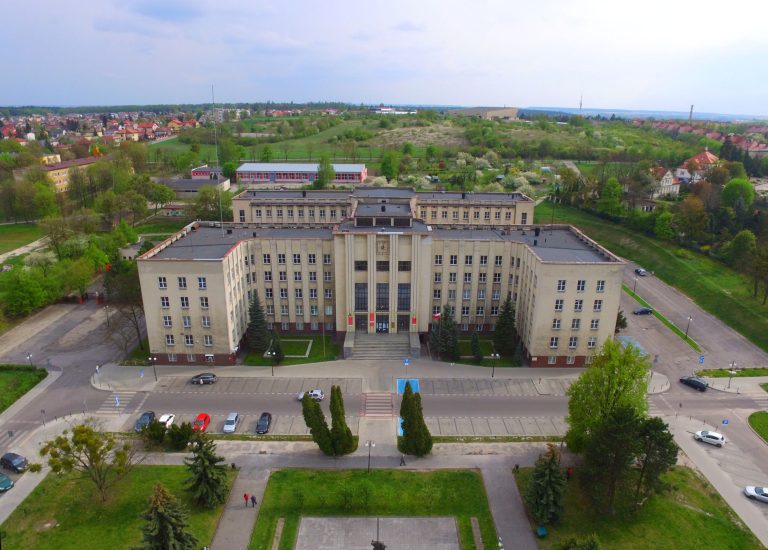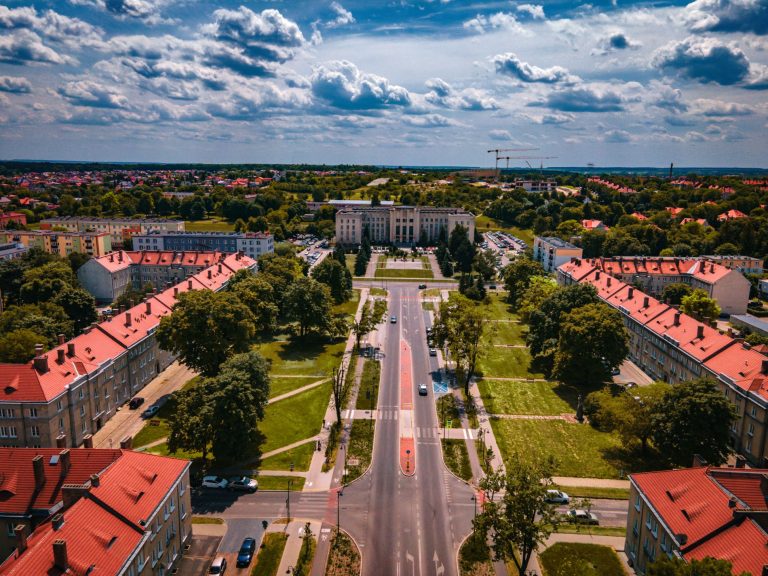
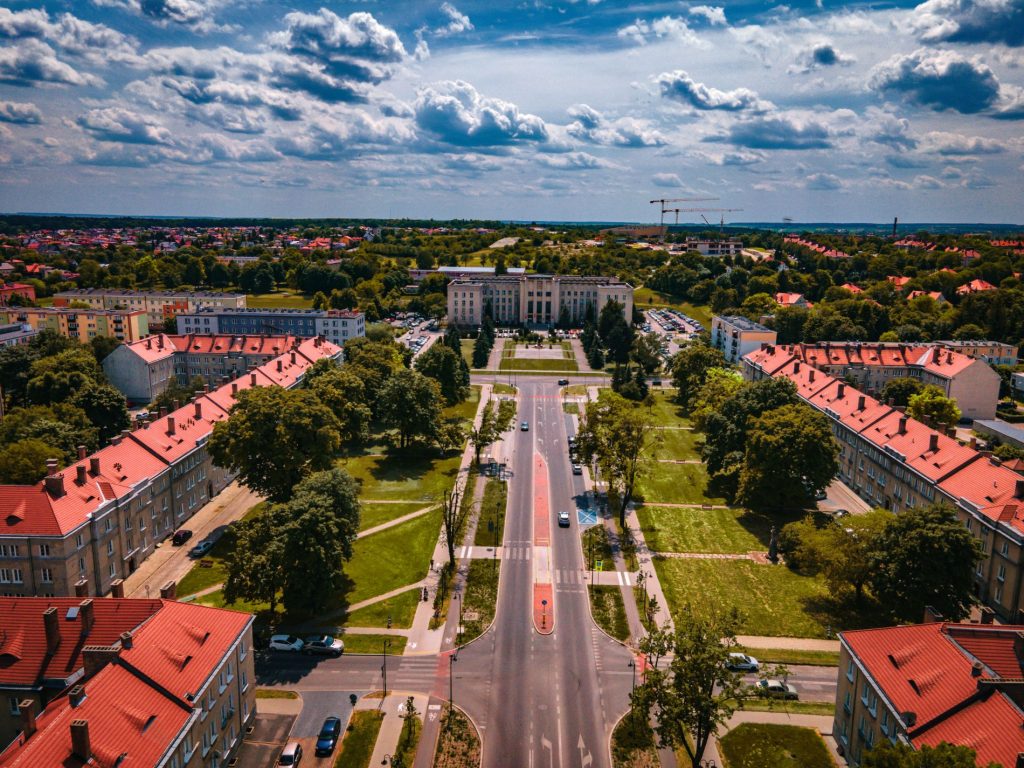
The walk is best started in front of the former management building, which was to be the main building of the emerging district. The project called for the construction of a five-story edifice with a volume of 71,400 cubic meters, consisting of 352 rooms for 748 employees. The building was planned on an H-shaped plan, with five full wings and two shortened wings. Above the entrance were the windows of a large two-story meeting room. In addition, the facade was to have a stucco finish with mica and a base lined with clinker bricks.
During the war, the building was used by German authorities. Among other things, it housed displaced persons from Greater Poland, and later functioned as offices of the Arbeitsamt. In the post-war period, the edifice was the seat of numerous institutions, such as district authorities, the Polish Railways, the ambulance service, banks, ZUS, educational authorities and PZPR structures.
In 1944, the building became the “hero” of historical manipulation, suggesting that the nucleus of the communist authorities – the Polish Committee for National Liberation – was established there. The Committee was in fact established in Moscow and, although it arrived in Chelm in late July, it moved quite quickly to Lublin. As part of the perpetuation of the hoax, Chelm was recognized as the “first capital of People’s Poland,” the “City of the PKWN” and the “City of the July Manifesto.” This is how it functioned in official propaganda and history textbooks.