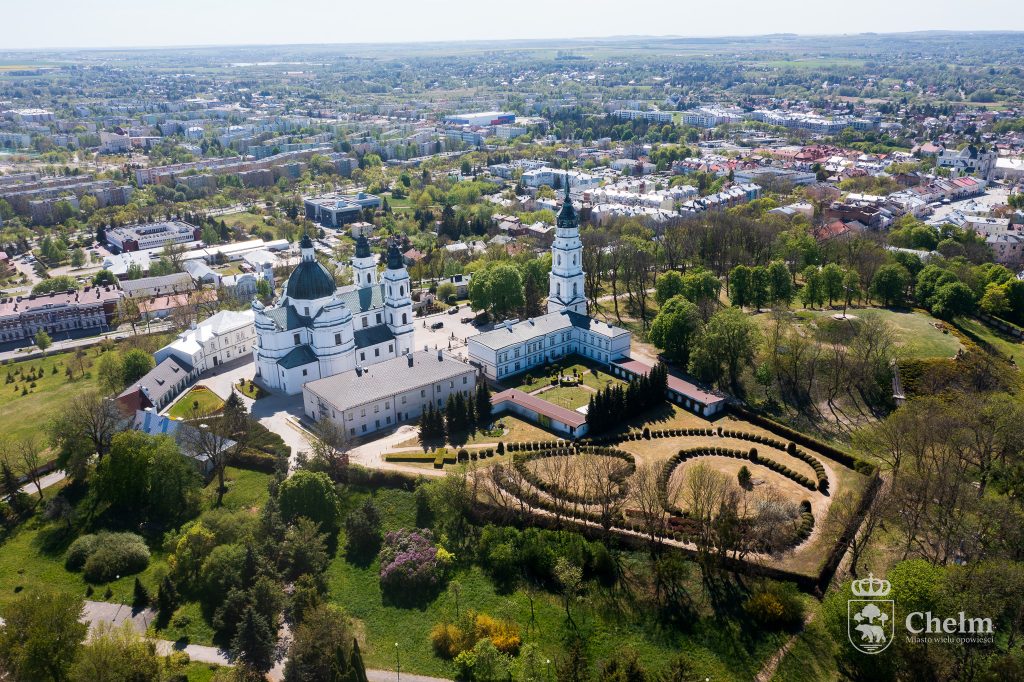
Chelmska Hill
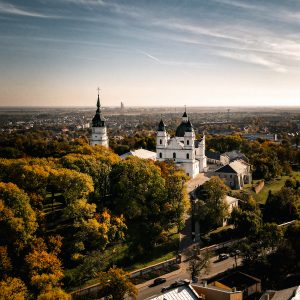
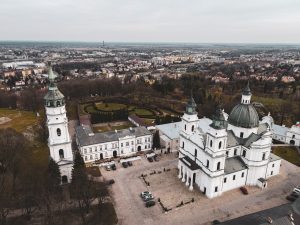
Chelmska Hill is a chalky hill that is the focal point and “picturesque finial” of Chelm’s skyline. In literature and documents it functions under many names: Castle Mountain, Cathedral Mountain, Old Town Mountain, and during the partition period – Sobor Mountain. The etymology of the city’s name is inextricably linked to this place – the Old Slavic word “holm” or “kholm” means just a hill. Originally, the name was used to describe a chalky hill dominating the surrounding area, and over time the name was passed on to the castle and town that had been founded at its foot. The first written mention of the town by this name appears in the 13th-century Halych-Volyn Chronicle, where it is described that the First King of Rus, Daniel Romanovich, while looking for a place to build a castle, learned from the locals that the place was called Chelm.
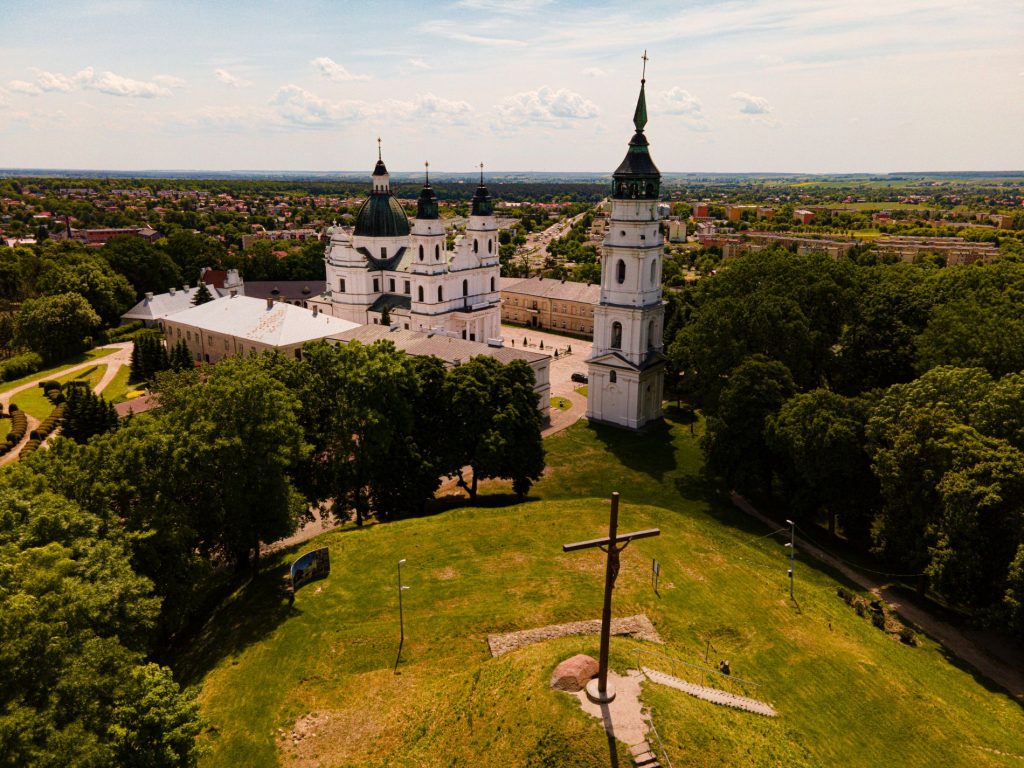
Other historical designations of Chelm Hill reflected its current political or religious role:
- Castle Mountain: the name is associated with the former defense system and the existence of the castle of Prince Daniel Romanovich, and later the starosts of Chelm.
- Cathedral Hill: This term emphasizes the hill’s role as the center of the diocese and the location of the basilica (the former Unican and Roman Catholic cathedral).
- Starostynska Mountain: A name used in the past, referring to the residence of the starost of Chelm located on the hill.
- Sobor Mountain: This term was used during the Tsarist era (after 1875), when the basilica was transformed into an Orthodox cathedral council.
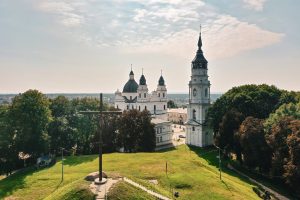
- High Hill (High Mountain): refers to the northern part of the chalk hill, which is an artificially raised mound 7 to 17 meters above the level of the main hill; it is the oldest settlement site, where Prince Daniel’s palatium was located.
Currently, the most widely used and promoting term for the city is Chelm Hill. As a geographic region, the area, along with the surrounding hills, is called the Chelm Hills
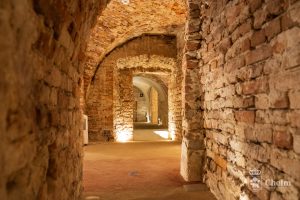
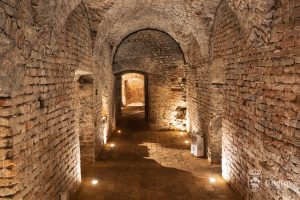
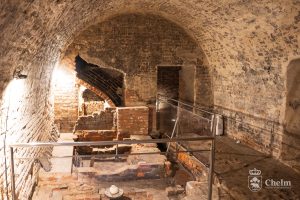
The hill brings together several important sights and attractions: an observation tower with a panoramic view of the city and the surrounding countryside, the crypts under the basilica, a high hill with a cross and a picturesque Way of the Cross around the hill, as well as a rosary. The centerpiece is the basilica with the miraculous image of Our Lady of Chelm.
The Rosary Garden nhe garden is also known as the Green Rosary or the Garden of Our Lady. It is located next to the Basilian monastery on Chelmska Mountain and is shaped like two hearts. In the garden space, bronze plaques designed by Stanislaw Stopyr are placed on natural stones with the mysteries of the Rosary. The plantings were designed to correspond in color and shape to the mysteries of the Rosary. The Joyful Mystery is symbolized by brightly colored bushes; the Mystery of Jesus’ Prayer in the Gethsemane – olive trees; the Mystery of the Flagellation – red bushes; the Mystery of the Crowning of Thorns – thorny bushes; the Mystery of Carrying the Cross – thorny bushes between boulders.
Architecture of Chelmska Hill
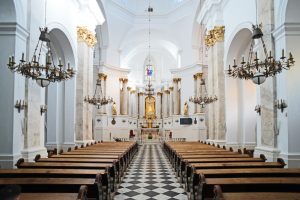
The basilica was elevated to the status of a Marian shrine, founded on the cult of the image of Our Lady of Chelm. Unfortunately, the original icon, which probably originated in Byzantium, was taken away by the Russians in 1915 and is now kept in Lutsk, Ukraine. Since the interwar period, only a replica of the image has been kept in Chelm.
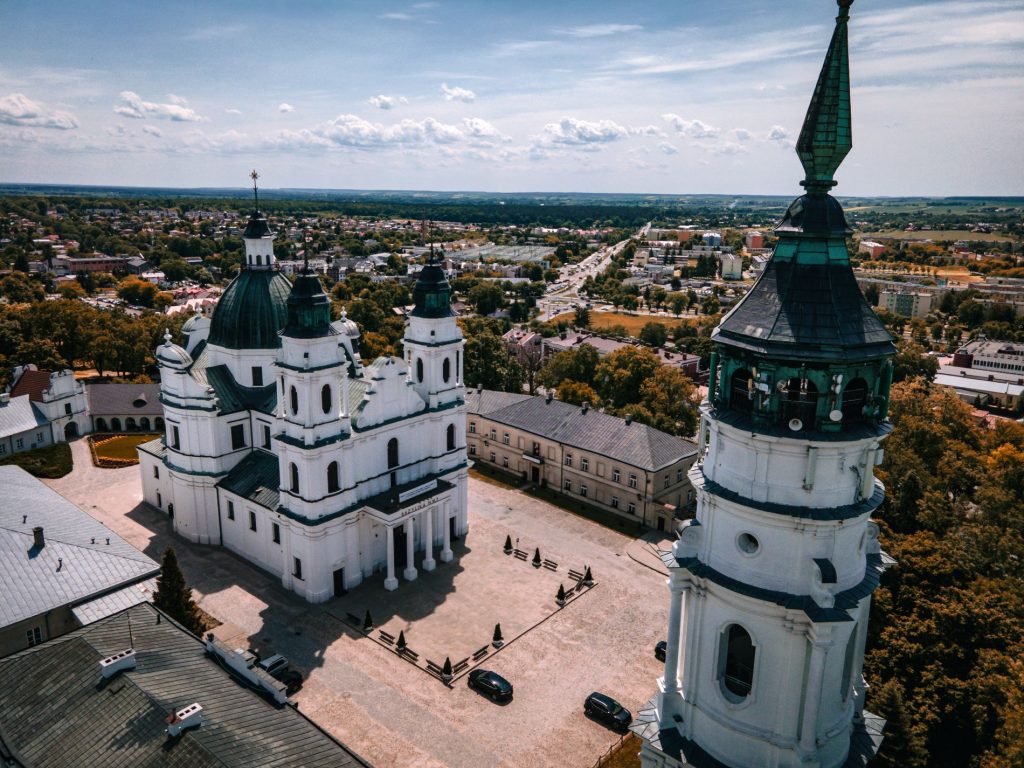
On the hill is a bell tower. It was originally intended to give the ensemble a Byzantine-Orthodox character. After the Catholics took over the ensemble, there were even plans to demolish it. Eventually it was decided to rebuild it and now the bell tower also serves as a lookout point. It measures over 40 meters high and has three bells.
The basilica is surrounded by a garland of buildings, among which is notable the Baroque Uściługskaya Gate, the oldest building in the city. The gate is integrated into a string of outbuildings, built in the 17th-18th centuries. The eastern part of the buildings houses the Pilgrim House, which was put into use in 1997. Particularly picturesque is the southern building, opened from the side of the courtyard by an arcade-pillar cloister. It is connected to the west by the Unity Bishops’ Palace. To the north of the basilica is located the Basilian Monastery.
The whole is complemented by modern realizations: Rosarium (Green Rosary) located in the former courtyard of the Basilians, and Chelm Calvary – a park-like Way of the Cross with bronze sculptures of great expressive power. There are also historic cemeteries on the slopes of the hill: an Orthodox cemetery and a war cemetery.